U1.L1 — Coupling Flows on 2D Toys
Flow-Based Generative Models · UFRJ · 2026.2
01Orientation and handover
Where this session sits
| Session | What happened |
|---|---|
| U1.T1 | a coupling layer has a cheap inverse and a log-det that is a sum |
| U1.L1 — today | you write it, check it, train it, look at it, read the library’s version |
| U1.T2 | what such a stack can and cannot represent |
Today is the first lab of the joint phase, and the first time a generative model is written from nothing and trained.
Three objects you leave with
- A bijection you wrote —
AffineCoupling, and aFlowthat stacks it. - Exact density evaluation —
Flow.log_prob, the change-of-variables theorem as code. - An independent Jacobian witness — autodiff, per example, float64, before and after training.
And one thing deliberately not on the list: an explanation of the last picture of the day.
Given code, three modules
| Module | Built in | What this lab uses |
|---|---|---|
common/train.py |
U0.L1, U0.L2 | set_seed; Trainer and its .fit |
common/toy2d.py |
today | three frozen generators, two picture helpers |
common/coupling.py |
today | the reference you rebuild |
The Trainer: five-step loop, schedule stepped per step, validation under no_grad every epoch, last.pt and best.pt, a CSV log. It expects (x, y) batches; a flow has no labels, so y is a placeholder and the accuracy reads nan — an interface preserved, not a defect.
Where the curves go
MLflow, deployed locally: sqlite:///mlflow.db next to the notebook, plus mlartifacts/. Portable — an offline bundle stands alone. Not a production recommendation.
mlflow ui --backend-store-uri sqlite:///mlflow.dbOne departure, measured: per-step logging turned a 14 s training into 48 s (a step is under a millisecond; a SQLite write is a few). So the loop runs without the tracker, and the two NLL curves (negative log-likelihood: the loss, on train and on validation) are logged per epoch, after the loop, with the config and the tags.
The sanity ritual, third appearance
\[ v^{\top}\nabla_\theta L \;\approx\; \frac{L(\theta+\varepsilon v)-L(\theta-\varepsilon v)}{2\varepsilon}, \qquad \lVert v \rVert = 1 \]
Float64, one fixed unit direction, mixed tolerance \(\texttt{atol} + \texttt{rtol}\cdot\max(|d_{\mathrm{AD}}|, |d_{\mathrm{FD}}|)\). Two extra forward evaluations, whatever the parameter count.
Today’s sibling: the suspect is a log-determinant. Analytic sum of scales, against a Jacobian that autodiff assembles independently, per example.
02toy2d: the datasets, frozen today
Three generators, one contract
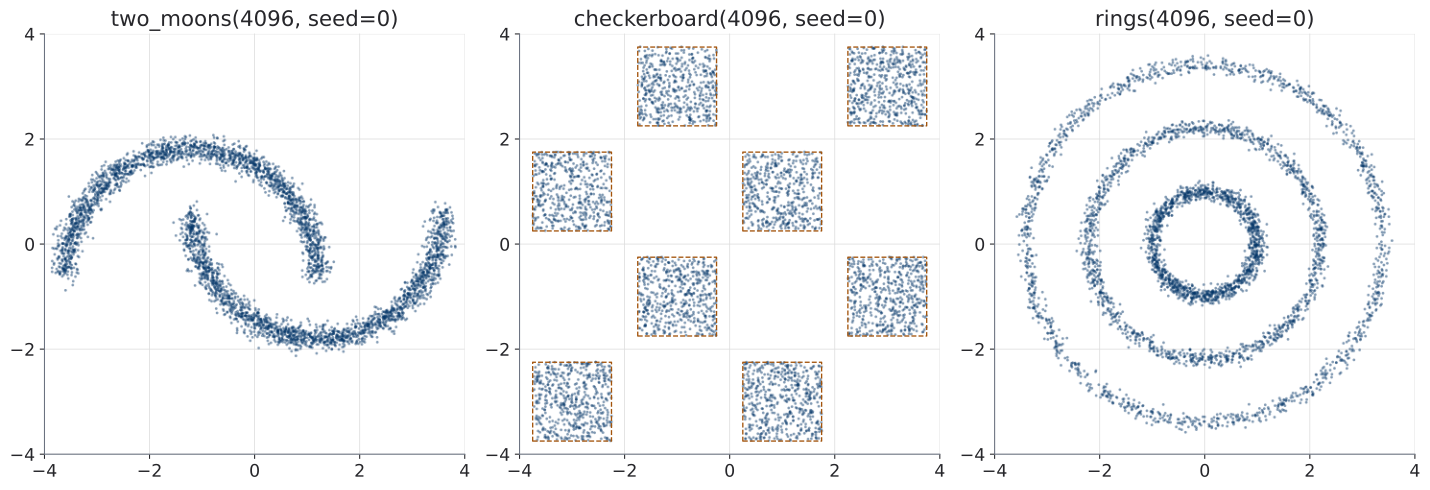
The contract
two_moons / checkerboard / rings (n, seed)
    -> Tensor (n, 2), float32;  EXTENT = (-4.0, 4.0)
density_heatmap(log_prob_fn, extent, n, ax)
    -> (xs, ys, logp)
warped_grid(generative_fn, extent, ax) -> lines- Pure seeded functions. Same seed, same pinned environment, same tensor, bit for bit.
- Float32, shape
(n, 2). - Literal zero-density gaps in the checkerboard: eight separated squares of side \(1.5\), no jitter.
Downstream sessions import this module by name and never redefine a generator.
The gapped checkerboard is a witness
- Mixture of eight squares of side \(1.5\), centred in the black cells of a \(4\times4\) board on \([-4,4]^2\).
- Nearest corners of two same-colour squares: \(0.5\sqrt2 \approx 0.71\) apart. White cells: no mass at all.
- The support of \(q\) is a union of eight disjoint closed squares; the density is exactly \(1/18\) on it.
That is a mathematical statement about literal support, and it is there because U1.T2 needs one. Today you only observe what a fitted density does in the gaps.
03An affine coupling layer, from scratch
The layer, generative direction
\[ \begin{aligned} \text{forward:}\; & y_A = x_A,\quad y_B = x_B \odot e^{s_\theta(x_A)} + t_\theta(x_A), \\ & \log|\det J_\psi| = \textstyle\sum_j s_\theta(x_A)_j \\[4pt] \text{inverse:}\; & x_A = y_A,\quad x_B = (y_B - t_\theta(y_A)) \odot e^{-s_\theta(y_A)}, \\ & \log|\det J_{\psi^{-1}}| = -\textstyle\sum_j s_\theta(y_A)_j \end{aligned} \]
Both sums come off the same conditioner pass: \(x_A = y_A\) is on both sides. In code, z is the source-side input (\(z_{k-1}\) of the T1 chain; \(z_0 = x_0\)), x the data-side output, mask marks \(x_A\) with True.
The interface is frozen
AffineCoupling(d, mask, hidden=(64, 64), s_cap=2.0)
    forward(z) -> (x, logdet_fwd)  # psi: source -> data
    inverse(x) -> (z, logdet_inv)  # psi^-1: data -> src
    # logdet_inv == -logdet_fwd, PER EXAMPLE
Flow(layers): forward / inverse / log_prob(x) / sample(n)
Permute(perm): both log-dets exactly 0
TODO 2.1 writes _heads, forward, inverse; the constructor and the conditioner (an MLP \(\mathbb{R}^{d_A} \to \mathbb{R}^{2 d_B}\), two heads) are given. Checkpoint: x[:, mask] == z[:, mask], and the log-det at init is not zero.
Bound the scale — the policy
\[ s \;=\; s_{\max}\tanh\!\big(\text{raw}/s_{\max}\big), \qquad s_{\max} = 2 \]
So \(|s| < 2\): every layer’s volume factor \(e^{s}\) stays in \([0.14,\, 7.4]\). Near zero the map is the identity; far from zero it saturates, so a random conditioner can neither overflow \(e^{s}\) nor divide the inverse by \(\approx 0\).
U1.T1 promised to show what the loss looks like when you forget. Next slide, measured.
Bound the scale — the measurement
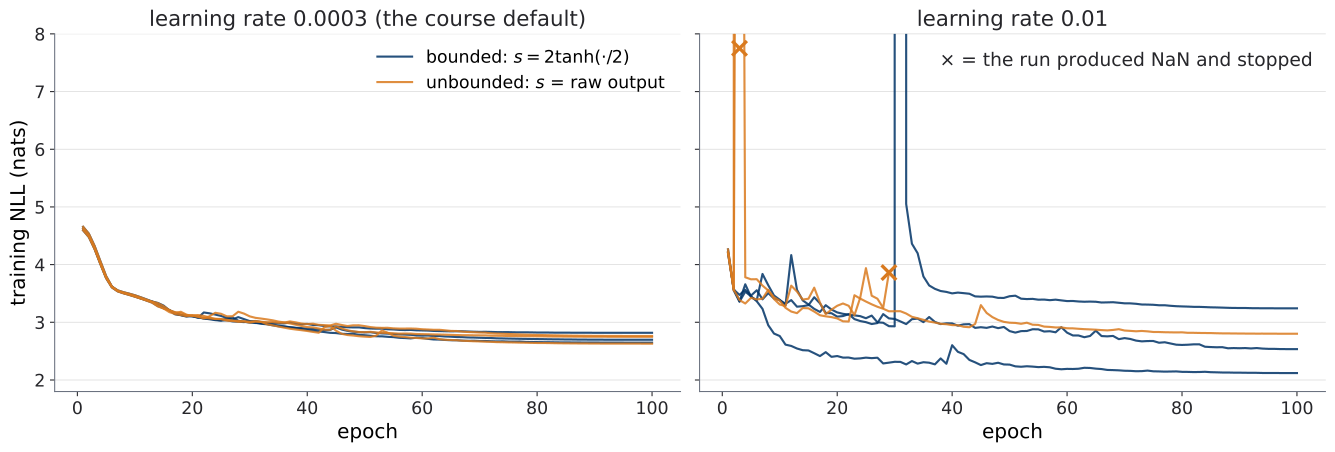
Why the head is not zero
- The recipe card zero-inits a last layer where “output \(\approx 0\) at start” is sensible — and an identity-at-start coupling layer is sensible.
- But a zero head gives \(s \equiv 0\): analytic log-det \(0\), autodiff log-det \(0\), perfect agreement on nothing. U0.L3 and U0.L4 both met this.
- So the head starts small and nonzero (default init \(\times\, 0.1\)). Measured at init, six layers, 64 points: \(\max|\log|\det J|| = 0.020\).
A check that cannot fail has verified nothing. The notebook asserts the log-det is nonzero before trusting any agreement.
TODO 2.2 — the independent witness
single sends one point (d,) to one point (d,). Accept under atol = 1e-10, rtol = 1e-8 on the largest log-det; assert sign > 0.
Measured, 64 points: gap \(5.3 \times 10^{-16}\) (tol \(3.0 \times 10^{-10}\)) untrained; \(5.1 \times 10^{-15}\) (tol \(2.1 \times 10^{-8}\)) after training, where \(\max|\log|\det J|| = 2.11\).
The pitfall: one determinant of the batch
torch.autograd.functional.jacobian(f, z) on the whole batch returns the Jacobian of the batched map \(\mathbb{R}^{Bd} \to \mathbb{R}^{Bd}\), shape (B, d, B, d).
Measured, \(B = 64\):
| Quantity | Value |
|---|---|
| largest off-diagonal block entry | \(0.0\) |
slogdet of the batched map |
\(0.24336826533634\) |
| sum of the 64 per-example log-dets | \(0.24336826533634\) |
One number for the whole batch. It cannot say which example is wrong; its plain det is a product of \(B\) factors and overflows for a trained flow; it costs \(B\) times the memory.
TODO 2.3 — both round trips
Per example, float64:
inverse(forward(z))\(\approx\)zforward(inverse(x))\(\approx\)xlogdet_fwd + logdet_inv\(\approx 0\) at matching points
Measured, untrained: \(8.9 \times 10^{-16}\), \(8.9 \times 10^{-16}\), \(2.8 \times 10^{-17}\). Trained: \(9.1 \times 10^{-15}\), \(2.7 \times 10^{-15}\), \(1.0 \times 10^{-15}\).
The third line is U1.T1’s Exercise 3, executed: the inverse pass reads the same sum with the opposite sign.
04Stack, and train
TODO 3.1 — compose, and the sign
Flow.forward: layers in order, log-dets add. Flow.inverse: layers reversed, each through its own inverse, log-dets add. Masks alternate.
\[ \log p_\theta(x) \;=\; \log p_0(z) \;+\; \log\big|\det J_{\psi^{-1}}(x)\big| , \qquad z = \psi^{-1}(x) \]
In code: z, logdet_inv = inverse(x); return log_p0(z) + logdet_inv. That is U1.T1’s \(\log p_0(z_0) - \sum_k \log|\det J_{\psi_k}(z_{k-1})|\) with the minus sign absorbed into logdet_inv. Written next to the implementation, so the sign is never implicit.
A permutation is free — in code
U1.T1’s Exercise 1 asked you to check in your head that a coordinate swap contributes \(0\) and undoes itself. Checkpoint 3.1 checks it in code:
Alternating masks and inserted permutations are two spellings of the same idea: after two layers every coordinate has moved.
TODO 3.2 — the closure is all you write
\[ \mathcal{L}(\theta) = -\,\mathbb{E}_{x_1 \sim q}\big[\log p_\theta(x_1)\big] \approx -\frac{1}{B}\sum_{i=1}^{B} \log p_\theta\big(x_1^{(i)}\big) \]
Everything else is the given Trainer.
Settings and budget
- Optimizer, schedule — the course defaults: AdamW at \(3 \times 10^{-4}\), weight decay \(0.01\); warmup over 5% of the steps, then cosine, per step.
- Model — \(K = 6\) affine coupling layers, conditioners of width 64, \(s_{\max} = 2\): 26,508 parameters.
- Budget — 500 epochs \(\times\) 16 steps = 8000 steps at batch 256. Measured: 69 s on a laptop core.
- Data — train
two_moons(4096, 0), validationtwo_moons(1024, 1). Selection on validation; there is no test set.
The relative checkpoint
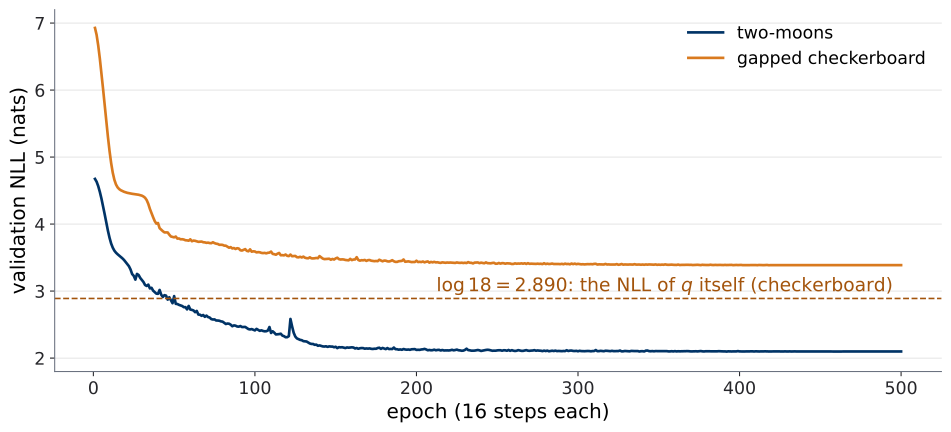
Pass if: the validation NLL at the end beats the first epoch’s by more than one nat, and the trained stack still passes the witness and the round trips.
| Run | Time | Val NLL, epoch 1 | Epoch 500 |
|---|---|---|---|
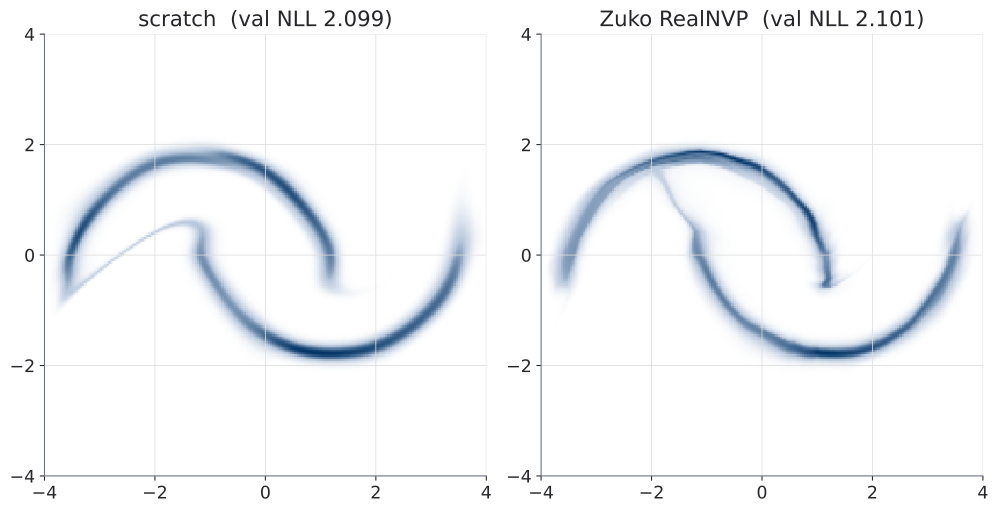
| two-moons | 69 s | 4.674 | 2.099 |
| gapped checkerboard | 69 s | 6.927 | 3.387 |
No absolute threshold: an absolute number is a promise about your hardware that nobody validated. TODO 3.3: same code, same budget, the checkerboard — one line changes.
Checkpoint — the curves
05Look at what you built
Two-moons: three views
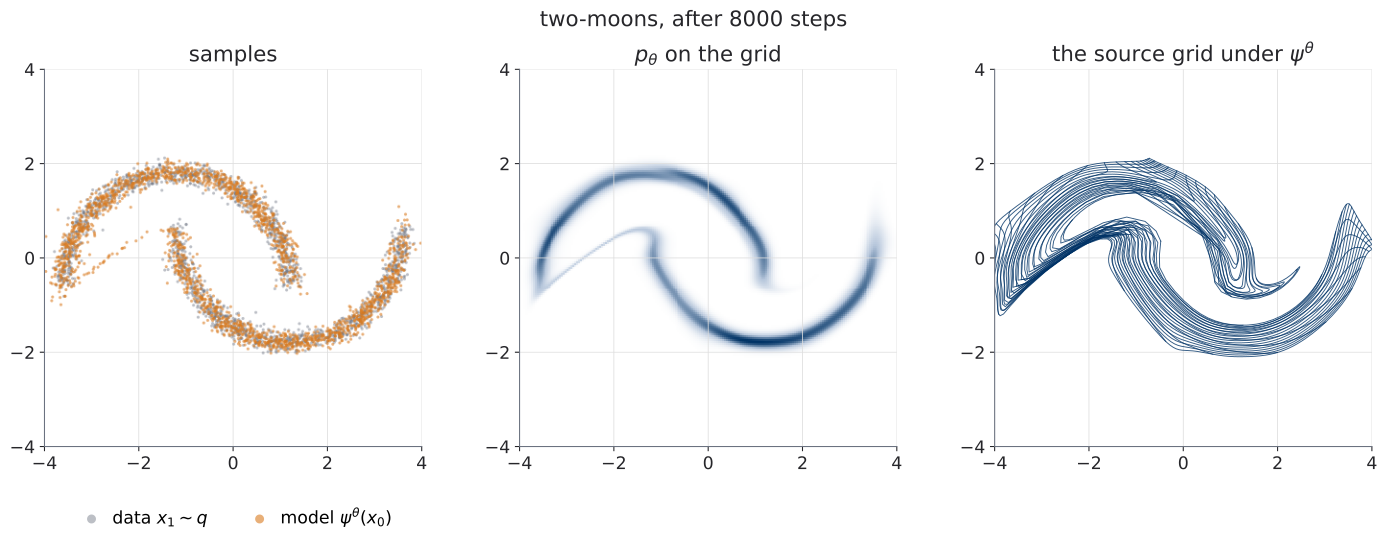
The warped grid is T1’s picture
- U1.T1 pushed one small cube through a diffeomorphism and read the density change off the volume change.
- This panel pushes the whole source grid through the learned diffeomorphism; the same reading holds cell by cell: large cell, density divided; crushed cell, density multiplied.
- The grid is one connected sheet, folded and stretched, never torn. A diffeomorphism cannot tear.
Keep that last sentence for the next figure.
The source grid, folded into the moons
The gapped checkerboard: three views
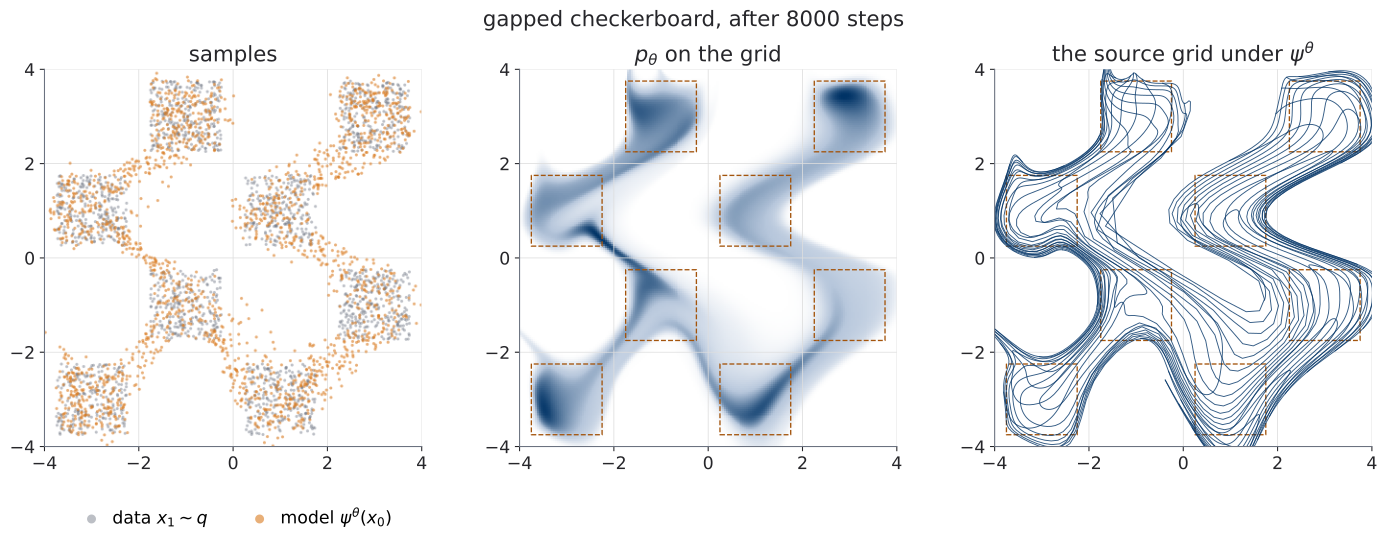
The question, and only the question
Important
What density does the model place in the hard-zero gaps, and what happens to the grid near those regions?
Measured on the reference model, \(400 \times 400\) grid:
- \(29.8\%\) of the model’s mass lies outside the eight squares, where \(q\) is exactly zero;
- along the corner-to-corner segment between two diagonal neighbours the density never drops below \(0.040\) (uniform level inside a square: \(1/18 \approx 0.056\)).
The bridges appear, and stay
The observation, and where it goes
- The grid is stretched across every gap — one connected sheet, eight bulges, material in between.
- The validation NLL stops \(0.50\) nats above \(\log 18\), the NLL of \(q\) itself.
Explained in U1.T2. The solution records the observation and says exactly that. Do not read the size of the bridge as a theorem: what is exactly impossible for this model, and what is an effect of finite capacity or of optimization, are separated in that session.
06The library cross-check
Board 1 — two costs, two dialects
course \(\psi \colon z \to x\) · library \(f = \psi^{-1} \colon x \to z\)
| Operation | Direction of \(\psi^{\theta}\) | Needs, per layer |
|---|---|---|
| Sampling | forward, \(x_0 \to x_1\) | \(\psi_k\) |
| Density / training | inverse, \(x_1 \to x_0\) | \(\psi_k^{-1}\) and \(\log\lvert\det J_{\psi_k}\rvert\) |
Zuko exposes the density transform as its primary object. Never flip the course convention to match a library; write \(f = \psi^{-1}\) and translate.
Same Trainer, one token changes
Zuko flows are nn.Modules whose call returns a distribution: flow() is \(p_\theta\).
Same data, same seeds, same optimizer, same schedule, same Trainer, same budget. That is the point of a cross-check.
The direction, asserted
| Map | Direction | Used by | |
|---|---|---|---|
| course | \(\psi\) | \(z \to x\) | sample, your forward |
flow.transform() |
\(f = \psi^{-1}\) | \(x \to z\) | log_prob |
flow.transform().inv |
\(\psi\) | \(z \to x\) | sample |
f.log_abs_det_jacobian(x, z) is \(\log|\det J_{\psi^{-1}}(x)|\) — your logdet_inv. Checked, not trusted: log_p0(f(x)) + ladj against flow().log_prob(x) on 1024 points, gap \(9.5 \times 10^{-7}\) (float32); f.inv(f(x)) returns \(x\) to \(3.3 \times 10^{-6}\).
The cross-check, passed
TODO 5.2 — source reading: two classes, one layer
Zuko splits the layer in two:
- the lazy class,
GeneralCouplingTransform— owns the mask and the conditioner (the hypernetwork), builds a transform on demand; - the transform,
CouplingTransform— does the arithmetic, and delegates the per-coordinate map to the affine map,MonotonicAffineTransform.
Your one class maps onto the three of them. The next slide says what to find in each.
TODO 5.2 — four things to find
| Your code | In Zuko | Find |
|---|---|---|
mask |
lazy: __init__; transform: split, merge |
which value is the untouched half; how NICE alternates it |
_heads |
lazy: meta, hyper |
what meta returns |
inverse |
transform and affine map: _inverse |
which of _call / _inverse is \(\psi\) |
| the two log-dets | log_abs_det_jacobian; call_and_ladj |
where the sum is taken; how the log-scale is bounded |
Line anchors live in the notebook, generated from the pinned zuko 1.5.0 at build time. TODO 5.3 is reserved (only if U1.L2 is cut).
07JAX, and the close
The same map in JAX
def psi(z):                        # ONE example
    x = z
    for first_is_a, ws, s_cap in params:
        ia, ib = (0, 1) if first_is_a else (1, 0)
        raw = mlp(ws, x[ia:ia + 1])
        s = s_cap * jnp.tanh(raw[0] / s_cap)
        x = x.at[ib].set(x[ib] * jnp.exp(s) + raw[1])
    return x

J = jax.vmap(jax.jacfwd(psi))(z)   # (B, 2, 2)
_, logabsdet = jnp.linalg.slogdet(J)
Trained torch weights, copied over. Agreement with torch on 64 points: log-dets to \(1.1 \times 10^{-13}\), forward maps to \(3.9 \times 10^{-15}\).
Three objects you own
| Object | Checked by |
|---|---|
a bijection: AffineCoupling + Flow |
both round trips, per example, before and after training |
exact density evaluation: Flow.log_prob |
the sign check; the training curves; a library within \(0.002\) nats |
| an independent Jacobian witness | torch.func and JAX, per example, float64 |
And one thing you do not own yet: an explanation of the checkerboard’s gaps. \(29.8\%\) of the mass outside the support; \(0.50\) nats above \(\log 18\). U1.T2 opens there.
What comes next
- Next session (U1.T2): it opens with today’s checkerboard and asks what a flow built from diffeomorphisms can and cannot represent exactly; then the rest of the zoo, and the depth question U1.T1 left open.
- Before then: finish TODO 4.3 in words, and use the notebook’s last cell to check your PS1.4(b) — the reference agrees with
Flow.log_probto \(1.8 \times 10^{-15}\).
Sources for today: (Dinh, Sohl-Dickstein, and Bengio 2017, secs. 3.2–3.3, §3.5), (Papamakarios et al. 2021, sec. 3.1.2), (Rozet et al. 2022).